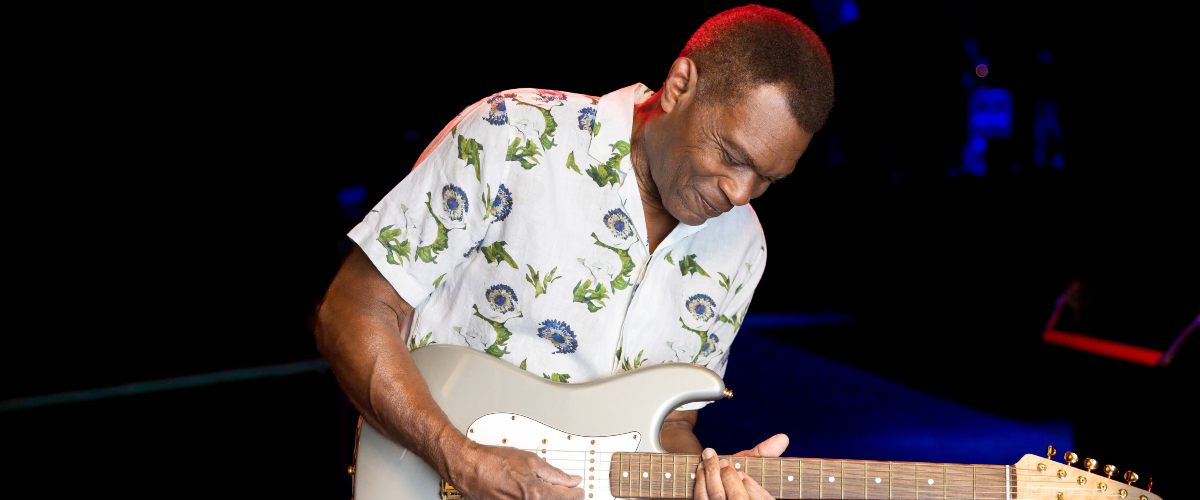
Robert Cray
Biography
Robert Cray
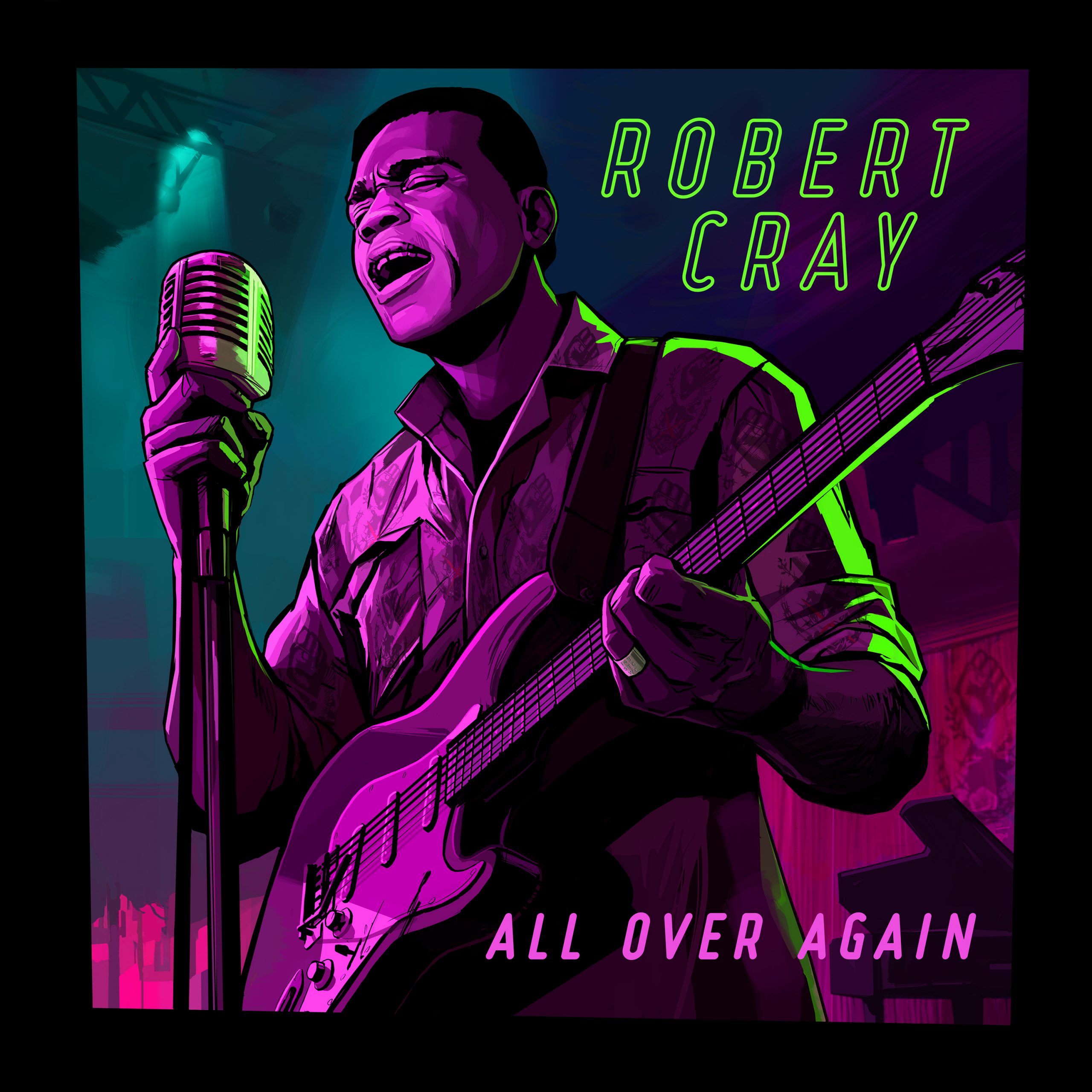
All Over Again
Blues icon. Soul man. Rock and roller. Robert Cray is all these things – and more. The Georgia- born son-of-a-soldier was raised on US Army bases, first picking up a guitar after seeing the Beatles on TV then, having witnessed Jimi Hendrix perform while still at high school, determined to follow a similar path. And so, he has across the past half century Robert Cray’s developed into one of American music’s most singular artists.
“I guess you’d have to say that we were lucky,” reflects Cray on his life in music, “because, growing up in the 1960s, the different music played on the radio really opened us up. I mean, we even had Albert Collins play our High School graduation party.”
Read More
From forming a teenage garage band, through to striding the stage alongside several of the world’s greatest guitarists, Robert Cray’s story is one of struggle and commitment. Struggle and commitment that led to Cray enjoying phenomenal success – selling millions of albums and countless concert tickets, winning five Grammy Awards, being inducted into the Blues Hall of Fame, recipient of the Americana Music Lifetime Achievement Award, designing two signature model Fender guitars – yet for Robert what’s always mattered most is the music.
Every note he plays counts, every song he sings is delivered as if it is his last: integrity and intensity are what has guided Cray’s musical career. He has never cheapened his output or delivered a substandard performance. Indeed, his commitment to making music of the highest standard has won Cray both a loyal audience and the respect of legendary artists.
Think about it: Robert Cray has shared stage and/or studio with the likes of John Lee Hooker, Muddy Waters, B.B. King, Buddy Guy, Chuck Berry, Albert Collins, the Rolling Stones, Eric Clapton, Tina Turner, Stevie Ray Vaughan, the Memphis Horns and Hi Rhythm Section. Cray’s stinging guitar playing and soulful voice, his skills as a band leader and performer, mark him as keeper of the flame for American roots music, an artist who never fails to deliver.
“We were so lucky just be able to see them,” says Cray of trading guitar licks on stage with legends of blues, rock and soul, “let alone share the stage with them – what an experience!”
Cray’s rise to the top was, like his music, a slow burn: he built a following in small towns across the Pacific Northwest, enjoying local hero status – so much so in 1978 he was cast (as a musician) in Animal House – before he released a record. 1978 was also the year Cray recorded his debut album, Who’s Been Talkin’, although Tomato Records’ internal problems held up Talkin’s release until 1980. And then, just as Talkin’ was gaining attention, Tomato collapsed into bankruptcy.
Got the blues? Young Robert certainly could have claimed he had them. But Cray isn’t given to complaining, instead he persevered, committed then, as he is now, to taking his music to the people.
After Tomato became music biz ketchup, Cray and his band – today consisting of Richard Cousins (bass guitar – there since high school), Dover Weinberg (keyboards) and Les Falconer (drums) – used the momentum the album gave them to play further afield. By now Cray was buddies with a young guitarist from Texas: Stevie Ray Vaughan.
“We played in 1979 at the San Francisco Blues Festival,” recalls Cray, “and I watched Stevie’s show and he’s just smoking. Afterwards Richard and I went up and chatted with him and we just hit it off. Stevie was great – if we were in Austin he’d always come and join us on stage.”
Signing to Hightone, Cray’s 1983 album Bad Influence established him internationally: he was invited to play Carnegie Hall as a guest of Willie Dixon, toured Europe, later finding Eric Clapton recording Bad Influence’s title track. 1985 saw Cray’s False Accusations album increase his standing as the foremost singer of blues noir songs, while that year’s Showdown! – a sizzling collaboration with guitarists’ Albert Collins and Johnny Copeland – won Robert huge acclaim from blues musicians and fans.
Signing to Mercury Records, Cray’s 1986 album Strong Persuader ensured he became the first blues/soul musician to breakthrough in the MTV era.
Strong Persuader won Cray rave reviews from pop and rock critics, topped charts worldwide, saw Cray grace the cover of Rolling Stone magazine and win the Grammy for Best Contemporary Blues Recording in 1988. Strong Persuader, with its songs of infidelity, guilt and unease, while not in any sense conventional Top 40 music, proved so strong an album it broke through barriers, sold millions of copies and would prove extremely influential.
Cray’s breakthrough allowed both young and older blues and soul musicians to gain wide attention and radio play: John Lee Hooker’s career resurrection came soon after with The Healer, and Robert plays on that seminal album.
“It was great to be able to travel around the world,” says Cray of Strong Persuader’s success. “It afforded us a lot of great opportunities that we were lucky to experience.”
Cray’s being modest: suddenly he found himself the hottest guitarist working – Tina Turner invited Robert to support her huge European tour (every night, after playing with his band, Cray would join Tina on stage to play “A Change Is Gonna Come”), then Keith Richards called, requesting Cray join the band backing Chuck Berry for Taylor Hackford’s celebratory1987 feature length documentary Hail Hail Rock ‘N’ Roll.
Here Cray not only got to play with the mercurial Berry (and Etta James, amongst many notable artists), he also formed a working relationship with Steve Jordan, drummer for the project and Richards’ solo band.
Now internationally famous, Cray found himself in intense demand: he toured with the Rolling Stones and Eric Clapton, played with B.B King and Buddy Guy (both of whom were inspirations), headlined legendary music festivals – these included Glastonbury in the UK and Crossroads Guitar Festival in the US – developing his sound and songwriting over a selection of strong albums across the 1990s.
Cray’s songs have addressed ageing, love, loneliness, domestic turmoil and US politics, while his music’s expansive vision found the likes of Cajun accordion legend Jo-El Sonnier and the Memphis Horns’ guesting on his albums.
Ageing like fine wine, Cray’s voice has developed a greater range and expressiveness – he’s put it to use on masterful interpretations of such Southern soul standards as ‘I Forgot To Be Your Lover’ (William Bell), “Your Good Thing Is About To End” (Mable John) and “Nobody’s Fault But Mine” (Otis Redding) – while his guitar playing now possesses an additional depth, gentle blue notes hint at a caress, then growl to signal emotional upheaval.
Working with Steve Jordan, now the Rolling Stones’ drummer, as producer, Cray’s recent run of albums – 2014’s In My Soul, 2017’s Robert Cray & Hi Rhythm, 2020’s masterful That’s What I Heard and 2027’s All Over Again – are amongst the very finest he’s made.
“Steve understands my sound,” says Cray of his working partnership with Jordan, “and he’s a killer drummer, so keeps me on my toes. We recorded All Over Again at FAME Studios in Muscle Shoals, Alabama, where the likes of Wilson Pickett, Etta James and Aretha Franklin all made seminal recordings.”
Every song on All Over Again is deeply felt. On “With Everyone” he pays tribute to his Alabama born mother, Maggie Cray who passed away in 2020, recalling how, aged seven, he joined Maggie and his siblings when they returned to small town Alabama to live with her mother for three months (the family subsequently reunited on a US base in Munich, Germany).
“We got a taste of what it was like for my mom living in the tiny house behind the church,” says Cray. “With an outhouse and having to boil water for a bath in the galvanized tub outside. We went to the same segregated school that she went to, and, in the town, there were white and colored drinking fountains, a real contrast to living on a diverse military base.”
The experience of returning to Alabama, alongside his frustrations with the current US administration, inspired Cray to write songs for All Over Again focusing on the state of the nation.
“1965, when voting rights for black people were enacted, wasn’t that long ago,” says Cray. “I turned 12 that year, my parents were finally able to vote. I’m not the first to write these types of songs. But I know why they are written – it’s just too bad that we have too.”
Unafraid to speak truth to power, Cray continues, stating “I think about my family and all of the other people whose lives were, or are similar and those who have served this country, to make the country and their own lives better. We work together. We don’t demonize people and we certainly don’t try to hijack this election process, like this government is trying to do.”
Alongside Cray’s originals, on All Over Again he tears up tunes originally cut in Muscle Shoals by R&B legends Bobby Womack, Wilson Pickett and Jimmy Hughes. While the album’s closing number, “Soul Shot”, is a joyous celebration of all the great soul singers who cut anthems the whole world now loves at Muscle Shoals.
“We move forward,” says Robert Cray of music, life and society. “We don’t move back.”
Read Less
Learn More
Press Releases
Photography
Click thumbnail to open high-res image then right click to save.